


The 90-Day Pre-Occupancy Management Framework
What the three months before the first resident moves in have to deliver — and why legal formation on its own does not make a community operational.
Registering a corporation does not make a community operational. A community also needs money, services, records, leadership and operating discipline, and all of it has to exist before the first resident arrives.
The framework below is the methodology Paul Bèl Kay and HoShing Realty & Associates use to mobilise a development in the ninety days before occupancy. It applies whether the structure is a registered strata, a homeowners association or a shared community — the governance model changes the authority, not the operational work.
What it took to establish one community
In one anonymised HOA assignment, the solution began with document review and a physical assessment, not with drafting a generic constitution. The team examined the sales and maintenance agreements, infrastructure, service gaps and owner priorities before recommending the legal and operating structure.
- Resident consultation and a formal vote
- Registration planning for a Benevolent Society under the Friendly Societies framework selected for that community
- A constitution and operational rules
- Board elections and governance procedures
- Initial budget, maintenance charges and accounting system
- Bank account and financial controls
- Supplier contracts and service transition
- Board training, document handover and ongoing management support
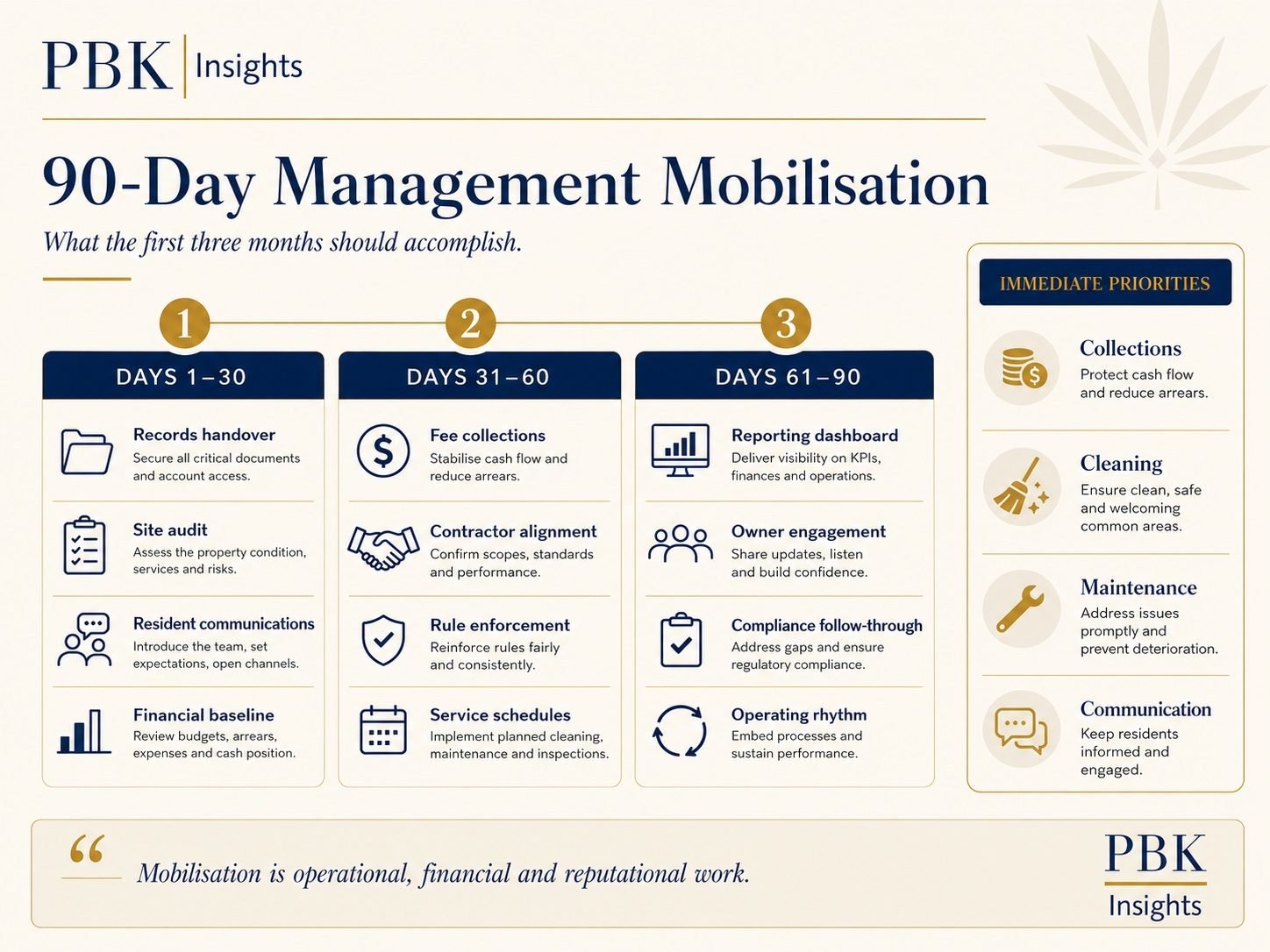
Days 1–30: establish the operating foundation
The first month is about taking custody — of documents, of accounts, of the physical asset and of the relationship with residents. Nothing later works if this is skipped.
- Records handover: secure all critical documents and account access
- Site audit: assess the property condition, services and risks
- Resident communications: introduce the team, set expectations, open channels
- Financial baseline: review budgets, arrears, expenses and cash position
- Confirm structure, roles and decision rights
- Approve the first budget and contribution schedule
- Activate banking, insurance and accounting
Days 31–60: mobilise the services
The second month converts the plan into services residents can actually see. This is where collections stabilise, because owners begin paying for something visible.
- Fee collections: stabilise cash flow and reduce arrears
- Contractor alignment: confirm scopes, standards and performance
- Rule enforcement: apply the rules fairly and consistently
- Service schedules: implement planned cleaning, maintenance and inspections
- Finalise suppliers and service-level expectations
- Receive plans, warranties, manuals and asset records
- Test security, utilities and emergency procedures
Days 61–90: establish the operating rhythm
The third month is about making the operation repeatable and accountable, so that it survives a change of board, a change of manager or a difficult year.
- Reporting dashboard: give owners visibility on KPIs, finances and operations
- Owner engagement: share updates, listen, build confidence
- Compliance follow-through: address gaps and meet regulatory obligations
- Operating rhythm: embed processes and sustain performance
- Issue the resident handbook and move-in rules
- Track defects separately from routine maintenance
- Establish monthly reporting and escalation
Who is responsible for what
Mobilisation fails most often where responsibility is assumed rather than assigned. Four parties carry distinct duties, and a manager cannot substitute for the legal authority of the governing body.
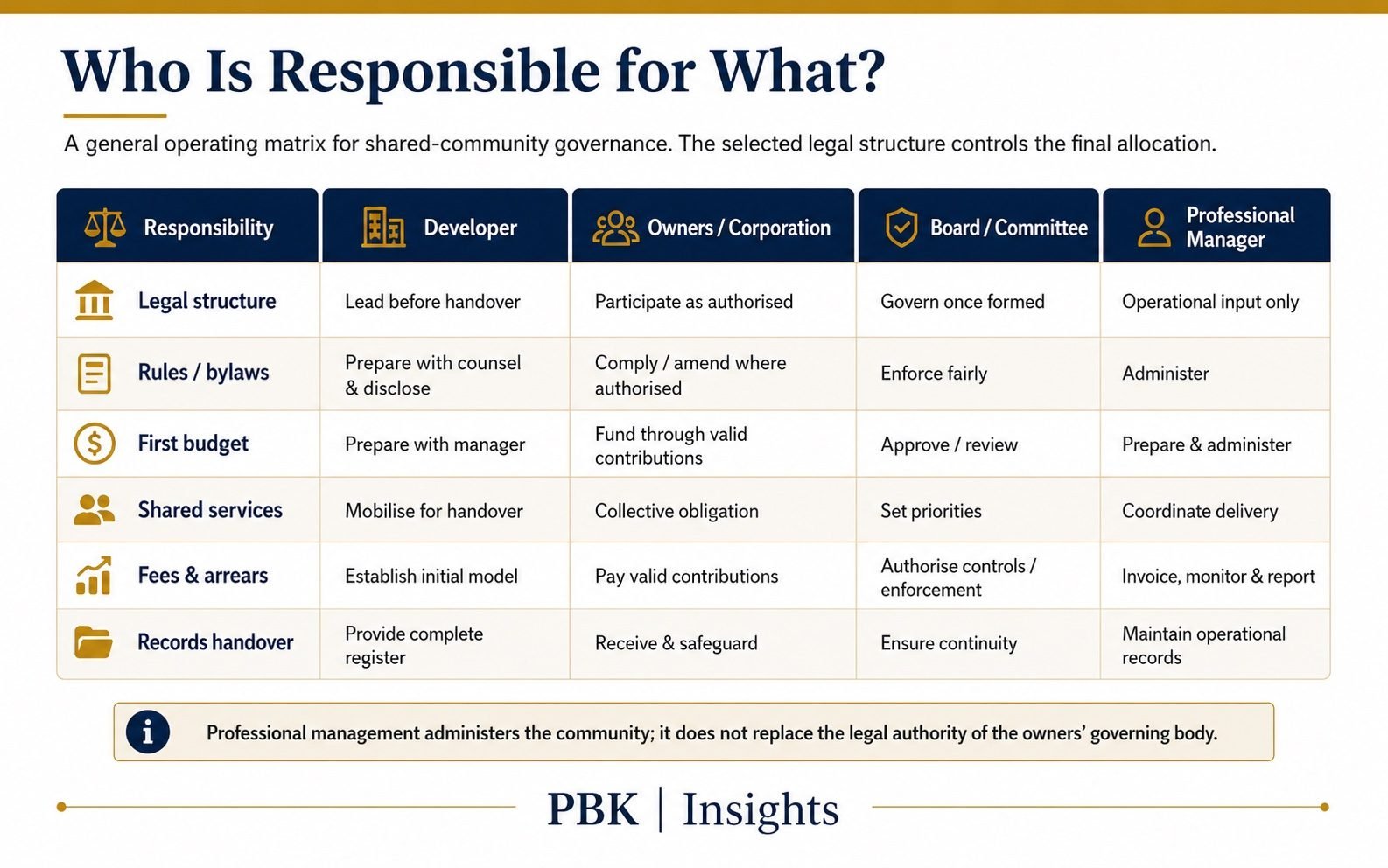
The developer selects and documents the intended structure, prepares purchaser disclosures and initial bylaws with legal advisers, and transfers records, warranties, contracts, keys, accounts and common assets in an orderly manner. The owners fund and comply with shared obligations. The board exercises the authority the documents and law actually grant it. The professional manager advises on readiness, administers the authorised systems and reports to the governing body — it does not replace it.